My very good friend Bill S. recently sent me a link to an article by creator Joss Whedon (whom I greatly admire and occasionally take to task) titled “Let’s Watch A Girl Get Beaten To Death.” (WARNING: Heavy, but important content — as if the title alone didn’t clue you into that…)
You should read it. It’s a well-written piece and fits nicely into a topic I’ve been thinking a lot about lately:
By creating this book, am I making the world less safe for women?
What This Article Is Not
Before I get into the reasons why that question is on my mind, let me get a couple things out of the way right up front. First off, to paraphrase another creator I both admire and hold to high standards, Aaron Sorkin: the sheer tonnage of what I don’t know about sexism and what it’s actually like to be a woman in this world could stop a herd of oxen in its tracks.
FACT: I’m a guy who dates guys and most of my activism has been on the behalf of gay youth and equal rights for gays and lesbians. Now, that doesn’t mean I’m going to sit on my hands about something this important, but I wanted to make it clear that I’m speaking from my heart here, not from a position of authority.
Secondly, I will not use this article as an excuse for hand-wringing and lament — the question of what responsibilities a creator has to his or her fellow human beings (in this case, over half the world’s population) is one I take very seriously. I might not say anything new here, but I am committed to finding the right answers. Knowing that violence and hatred towards women is one of the biggest challenges of our day is important, but more important is asking: what am I going to do about it?
Yaoi 911: Weapon of Sexism?
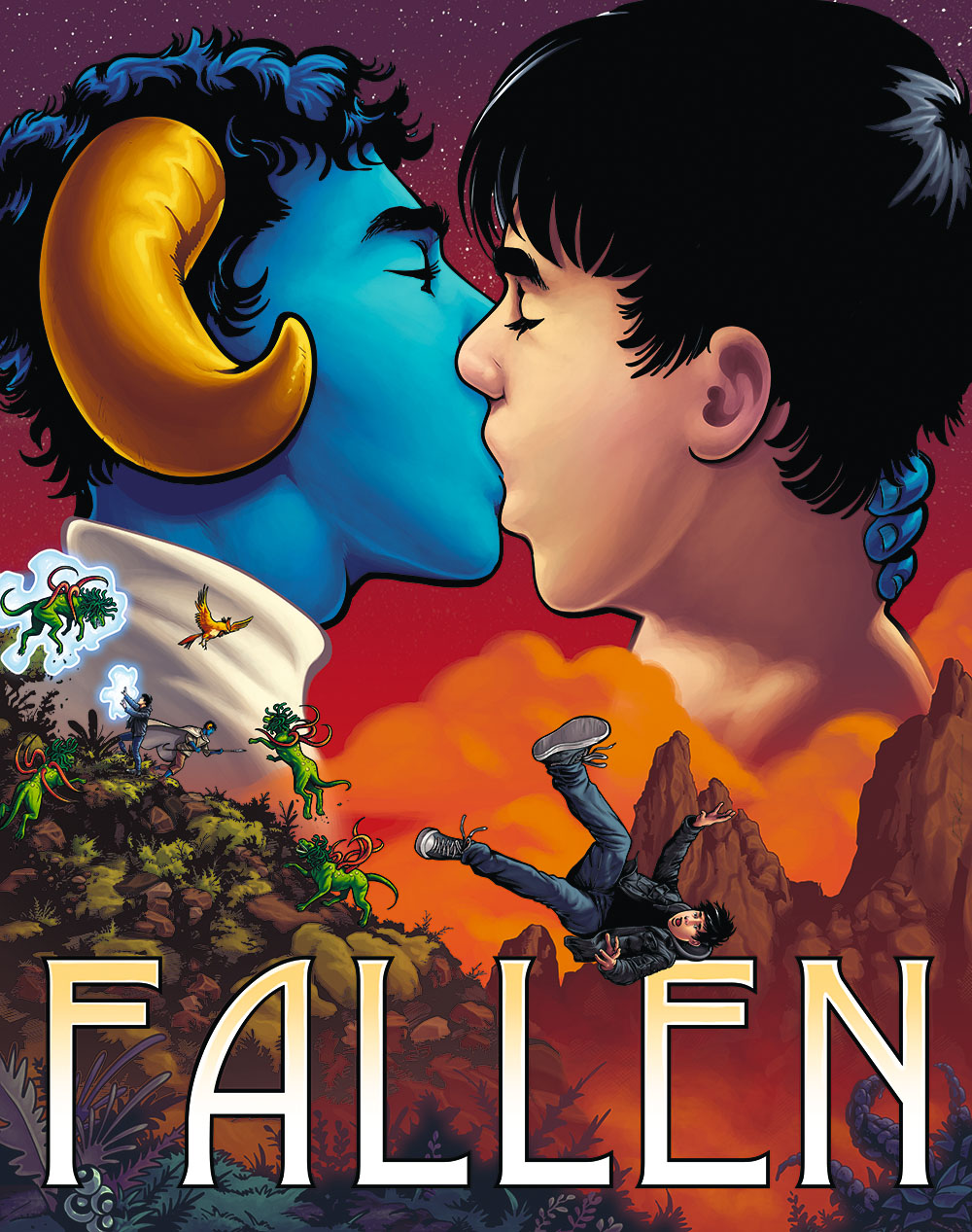
As a creator, I focus on writing what I consider to be compelling, entertaining stories and take stock of the thematic content of what I’ve written afterwards. And while I’m quite pleased with the stories I’ve come up with for this first book, there’s been a little something niggling at the back of my brain, something about how I’m representing women.
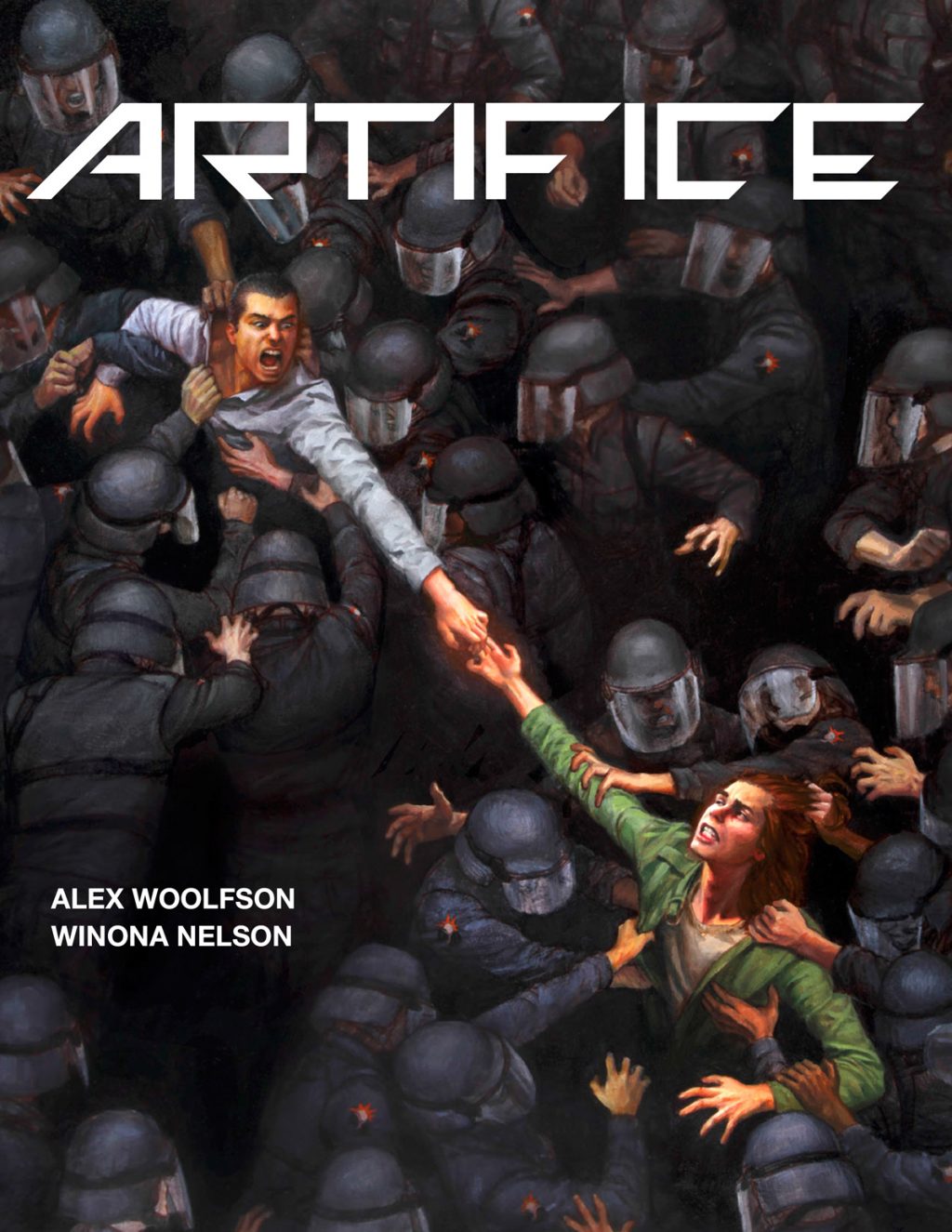
In these comics, my heroes are all male. In fact, most of the characters in my stories are male (in “A Shot in the Dark” they are all male). Nothing wrong with showing a guy being a hero — and this is yaoi, after all — but it did feel a little strange to exclude, you know, half the world’s population. So, in “Artifice”, I created Dr. Clarice Maven. But the hero slots were taken up by my romantic leads so if she was going to take a leading role that meant she had to be the antagonist — y’know, the villain.
Now, as written, Dr. Maven is very smart and powerful — so at least I avoid the basest of sexual stereotypes — but still, she’s not on the side of angels. And these are action stories, so the threat of violence is always there. The threat of violence against a smart, capable woman and, because she’s the villain, your sympathies are going to be with the male heroes, not with her.
Women’s inferiority – in fact, their malevolence — is as ingrained in American popular culture as it is anywhere they’re sporting burkhas. I find it in movies, I hear it in the jokes of colleagues, I see it plastered on billboards, and not just the ones for horror movies. Women are weak. Women are manipulative. Women are somehow morally unfinished. (Objectification: another tangential rant avoided.) And the logical extension of this line of thinking is that women are, at the very least, expendable.
I’m not going to coyly ask “Could my story be contributing to that culture?” The truth is, on some level, it does. Perhaps the effect is subtle, but then so is the common use of the word “gay” in popular culture for anything negative or weird. And that certainly had an effect on me growing up.
First Amendment: Rah! Rah! Rah!
So what about that? Do I think there should be laws, censorship, perhaps a governing council of wise hate-free elders to tell creators what is and is not ok for them to create?
No — not only is that unworkable, but I’m certain that the end result would create more evil in the world, rather than less. I might not be as hard core a defender of Freedom of Speech as my good friend Bill S., but the issue is still very dear to my heart: so long as no one in real life is placed in clear and serious danger — think death threats — creators should be able to create whatever they want without fear of censorship.
And in my opinion, potentially contributing to social injustice, while reprehensible, shouldn’t lower the legal axe. If for no other reason — and there are other reasons — than that such works can get us talking about the issues. And hopefully, through reasoned discussion, change the world for the better.
A Creator’s First Responsibility
In fact, I would go so far as to say that, for a writer of narrative fiction, trying to make the world a better place should take second place to good storytelling. And by good storytelling, I mean a commitment to creating compelling characters who feel real doing interesting things.
We’ve all read books or seen films where a creator tried to shoe-horn in a social message that went contrary to the reality of the piece and we are well-familiar with the results — tedious works that fail as art and as instruments for positive change.
And of course, a commitment to showing what is interesting and true about people can contribute to understanding and thus further social progress in itself. That is, by not creating propaganda, artists are often more successful in changing the world. Not every gay person is harmless and non-predatory. Not every black person is a shining role model for their community. Not every bigot hates their kids and kicks their dog. To only write works that say otherwise is lying. And by telling the truth, by showing both victims and perpetrators as human, you force your audience to identify with them, to find traits of what they were so sure was the “other” in their own hearts and minds. And I believe that that can only help the fight to end prejudice, bigotry and violence.
But not every story that has the ring of truth has the potential to bring us together. I haven’t even seen the trailer for it, but who knows? Perhaps the film that Joss refers to in his article — “Captivity” — is close enough to real life to count. Maybe it carefully and truthfully narrates exactly how a beautiful woman would behave if held prisoner and tortured for days.
What about these works and their creators?
Creator or Human Being?
I’m reminded of a course I took while a student at the University of Salzburg called “Science and Ethics.” (I actually took a number of ethics classes while studying there and it was a fascinating experience. And of course, the Austrians know a thing or two about how a deep commitment to a scientific or political pursuit can be used as an excuse to justify the most abhorrent actions.)
The point of the class was very simple: As a scientist, your first and really only commitment is in discovering scientific truths by any means necessary. But as a human being, you are responsible for how your actions impact others — and that responsibility trumps your role as a scientist.
A creator’s first and really only commitment should be to tell a great and effective story. But as human beings, we have a responsibility to carefully consider the impact of our works on the larger world, on our fellow human beings. And that responsibility trumps.
This Human Being’s Responsibility
I think it’s dangerous to judge people on the basis on any one action and dangerous to judge a creator by viewing any individual work in isolation. And frankly, it’s arrogant to think that any one story will have that big an impact on the world stage. But a number of pieces over a creative career, a body of work is another matter.
I look at the stories I’ve created for this first book through the lens of sexism and, honestly, I think I can do better. They’re good stories, I think people will like them and I don’t think they’ll make the world a darker, more dangerous place. Or at least not much darker and more dangerous. But I absolutely think I can do better on the next ones.
What that will look like exactly? The guys still need to be the heroes, right? Or do they? Is it enough to have a plucky and capable female best friend or is that just as insidious as the sexless and funny gay best friend stock character in Hollywood movies? Truthfully, I don’t know what the right answers are yet.
But as a creator, it’s my universe and I get to choose what truths I’ve noticed about people, about women, about men relating to women, that I will share. I know in my heart there has to be a way to tell hot, fun, sexy, compelling yaoi stories that can make this world safer for the cool female audience who will read my works — that I can still make telling great stories my top priority and yet be part of the solution, not part of the problem.
A good creator should be able to do it. And this human being sees it as his responsibility.
Enjoy reading articles like these? Don’t miss out! Subscribe and get them delivered right to you!
Psst! Want a free yaoi full-color yaoi comic? Just sign up over at our Free Comic page and we’ll send you the download link!
Learn More!
- Want to hear some of my early thoughts on yaoi and sexism? Check out Should Yaoi Be Just For Women?
- Curious about how to create your own manga? Start with How to Write a Full Comic Book Script and How to Find the Perfect Yaoi Artist for your Graphic Novel!
- Want to see how our first comic is coming along? (Or just want to look at some pics of the cute boys fighting monsters and making out?) Click on over to Yaoi Art: “A Shot in the Dark” Inks! (Age 18 and over, please!)
- Had enough with the heavy for now? Read a review of a great yaoi comedy: Yaoi Review: Challengers by Hinako Takanaga!


Comment by Nonie
1 July 1, 2007, 7:03 pm o'clock |
Writing males in a sensitive way is just as important as writing strong females when it comes to making an impact on sexism. Half the problem is in the way men are portrayed. It gets a lot less attention because people view the macho male character as strong and empowering - the fact is, the average male character is just as stereotyping and imprisoning as the average female, just in different ways. Men are told they HAVE to be strong and unfeeling and macho, so of course these traits can’t belong to women, just as being caring, nurturing, loving, and weak all go to the women and can’t belong to men. So when you’re writing a story with a mostly- or all-male cast, you can still make very effective arguments against sexism by making your men *real*, 3 dimensional men with feelings - which is something in which yaoi is already far ahead of many other representations of men in the media. There’s always room for improvement, but a big reason why I like yaoi stories is exactly that - as exaggerated and cheesy as if often may be, these men can feel and love.
So really… Though you’re doing right by keeping your portrayals of females in mind and committing to improve your own writing, by promoting this genre you’re already helping on the other front, male representation.
Comment by Abigail
2 July 26, 2007, 10:18 am o'clock |
Okay I admit it. I read your story one evening and I barely noticed that there was violence against a women. I was so on the edge of my seat I didn’t care what happened to Dr. Maven. So what does that say?
Shouldn’t I have noticed? I consider myself a feminist and I’ve worked at a shelter for battered women before.
But honestly I think it’s okay that I didn’t see it as violence against a woman or have some huge reaction. I didn’t notice because all the characters were so 3-D, men and women. I agree with Nonie above. Unraveling our images of what men need to be is at least as important as unraveling our images of women need to be. Your male characters did just that for me and I loved them for it. So much so that I didn’t consider the gender of their antagonist. I only worried about them because they had all the complexity of a real human being. Yeah, they were strong and tough but then they were soft and weak too. Focusing so much on them I only saw Dr. Maven as a villian.
Does your story make the world a darker place. No I don’t think it does. Not even a little bit. Not for me anyway. Male villians are killed off all the time in movies and we rarely as a culture worry about what that does to the image of men or their safety. If a female villian can’t get hurt doesn’t that just put her in some kind of Victorian hell? She’s stuck up on that pedastal and has to be protected and pampered at all times lest she faint. I think if you could talk to Dr. Maven and ask her if she should be protected at all times because she is woman or if she should take her lumps with the male villians I think she’d want her equality. (Of course, she is a smart bugger so she might try to wangle her way to freedom.)
I think someday you will write a piece with a wonderful female protagonist and in the meantime I’ll enjoy watching and reading as you take the journey.
Comment by Alex Woolfson
3 July 27, 2007, 3:45 pm o'clock |
Winona,
You make a very good point. While I’m not willing to let myself off the hook for being responsible for the portrayal of my female characters, I hadn’t considered that a 3-D portrayal of men behaving well (in addition to being vulnerable, etc.) was also offering a positive contribution to this problem. So thank you for that perspective.
Abigail,
And you make a good point as well about how disposable men can be in popular media — something that is rarely questioned as a form of sexism. I’m not sure Dr. Maven would volunteer for any lumps, smart bugger that she is, but you’re right, placing women on a pedestal isn’t very useful either.
Thank both of you for your kind words and encouragement. Like I said, I’m still not letting myself off the hook with this issue, but you both make compelling arguments that the portrayal of men in a story is as important as the portrayal of women. And that more vulnerable, more emotionally available portrayal of men is certainly something that attracts me to the best of yaoi as well.
Comment by Shinkaishi
4 August 1, 2007, 3:57 pm o'clock |
Hmh, I definitely have to agree with you that as an author, an artist, or any person with a certain public influence, as small as it may be, you should feel a certain responsibility about how you with your work can manipulate others, however, in one of your central points, I think I cannot.
First, I should perhaps state that I have been reading your website for a while and given the fact that there are not so many, or at least, not so many visible male yaoi creators and also given the fact that I am a homosexual male as well, I found it quite interesting.
However, I should note that I have not and will never be a feminist.
You say that “violence and hatred towards women is one of the biggest challenges of our day”, but I do think that is wrong. The challenge, perhaps even really the most important one in all human history, is the violence and hatred among humans, towards humans committed by humans…
The violence and hatred of a majority towards aminority, of the minority towards the oppressing majority, in families, among nations, religions, any groups you might think of.
Why always narrowing things down to one group and then overlooking the other? After all, according to a study in Germany for example, the vast majority of all violent crimes, of all violent acts, is committed by men towards men, and at least as far as I know, this is little different for example in the United States .
So, why does it seem to shock people so much more, when a woman is the victim of violence, of hatred?
You say that you cannot know how it is to be a woman and I think no man can really and truly say he does, but neither can any woman say in all honesty how it is to be a man, nor can anyone ever truly say, how it is to be any person besides himself…
Social conventions have bound women to “home and hearth” and man to work and the responsibility for the existence of an entire family, racism has struck the ones with discrimination and the others with fear and blindness, homophobia has not only harmed those it is directed at but also denied heterosexual (men) normal intimacy, tolerance or simply closeness at the base of an ever present suspicion…
But lastly, emancipation movements are primary of course intent to pursue the interests of whom they represent. I think though that it is often not enough. People should not be labelled as blacks with all the stereotypes bound to that image, but as what they are, simply humans with a dark skin, when two boys/ men hug they should not have two worry about “being gay” and lastly the sex of a person should only matter in topics related to the act of sex itself (I recall a character in an Agatha Christie- story making a statement of that nature, and that is more than half a century in the past…).
There have been so many “new discoveries” over the time which made the very fundament of so many of our gender stereotypes and clichés crumble, about violence, about genes, about abilities, about love…
Why therefore still tread men and women so differently? Shouldn’t you just worry, whether or not you represent Humans fairly?
Abigail wrote that she did not even notice it (I should note though perhaps, that I have unfortunately not read your story… *blush*) as “violence against a woman”, and I do think that this is what it should be, because it does mean that the characters aren’t men or women but humans, who can be villains, heroes, weak, strong, brave, cowardly, loving, cold…
“Not every black person is a shining role model for their community. Not every bigot hates their kids and kicks their dog”, that you wrote yourself, and thus, not every woman has to be good, or strong and smart. You should worry about your portrayal of female characters, I would say, if every one you write about is a manipulative, sadistic devil, etc., or perhaps rather, if you discover, that female characters not only in your stories, but also everywhere else are portrayed that way. Because, if you do, if you worry more about your female characters and their correct portrayal than about the male character’s, you ultimately only do contribute to the inequality in another way.
Chauvinism has always two sides, and it is both of them which are hurt by it, just in polar opposite ways.
Comment by Alex Woolfson
5 August 1, 2007, 8:26 pm o'clock |
Shinkaishi -
Thank you for writing. You make some good points and I agree that bigoted prejudice and discrimination against anyone — regardless of their race, sexuality, gender identity, etc. — is the ultimate enemy we must fight. And in an ideal world, the only distinctions we would make would be based solely on the content of a person’s character, not on irrelevant physical/ethnic traits.
That said, it is my belief that we live in a world where those who are minorities or those who wish to end prejudice and hate-based crime don’t have the luxury to ignore those distinctions. Yes, men experience violence here in the United States and it wouldn’t surprise me to find out that, based purely on numbers, more men are killed by other men than are women by other men. Yet studies show that when women are the targets of male violence they are shot, stabbed, beaten many more times than men who are similar targets. It seems that while men are stabbed just enough times to kill them, women receive multiple wounds far above and beyond the number required. This finding is apparently consistent. And there is one other group that receives the same treatment — homosexual men.
As a young gay man I was very influenced by a talk given by Suzanne Pharr (whose book Homophobia: Weapon of Sexism cites the study I just mentioned). Based on her talk and other experiences I have had, I’ve come to believe that there is a strong connection between sexism and hatred towards gays and lesbians. So, yes, as a human being, it is my wish and responsibility to end hatred towards all beings. But as a gay man, I feel a special calling to fight sexism in particular. And it’s a strong motivator for me.
But I think the point is well made that I have as much a responsibility towards my portrayal of men as I do towards my portrayal of women. And I will absolutely keep that in mind as I create my own body of work.
Thank you again for your thoughts.
Comment by silkeyes
6 January 28, 2008, 9:41 am o'clock |
when it comes to gay ,people tend to show their disgust openly but they don’t tend to empathize with them, because people they never pose the question to themselves “what if i was gay ?” .they bring critics but they are incapable to put themselves in the shoes of this kind of person .It’s true when psychologists say : “it’s not a problem with them ,it’s with us “This quote if i can name it this way it’s true because they are not abnormal we consider them to be this way plus of that not many gay show themselves in public because they already think about of what others will think if they see them .Being gay is not something you decide to be it’s something you are born with it’s not something you can control and it’s not their fault that they are born like this is our fault for looking down on them because they are not “like the rest of us “.They aare as normal as we ,are simple people with likes and dislikes but because of our mentality we are not ready to consider them being as normal as we are .So in the end it’s the society who decides once again for you …..and the others who point with the finger without thinking that someday their children might be gay and then what will they do ??? chase them or accept them for who they are …i guess we’ll never learn until we experience it ourselves ….